Tuesday, January 29, 2013

19th Century Gambling


  Gambling has always been a human pastime. Many of the popular casino games in the 19th Century originated in Europe and China. Games such as craps, baccarat, roulettte, faro, and blackjack had their origins in different areas of Europe, while keno derived from an ancient Chinese lottery game.
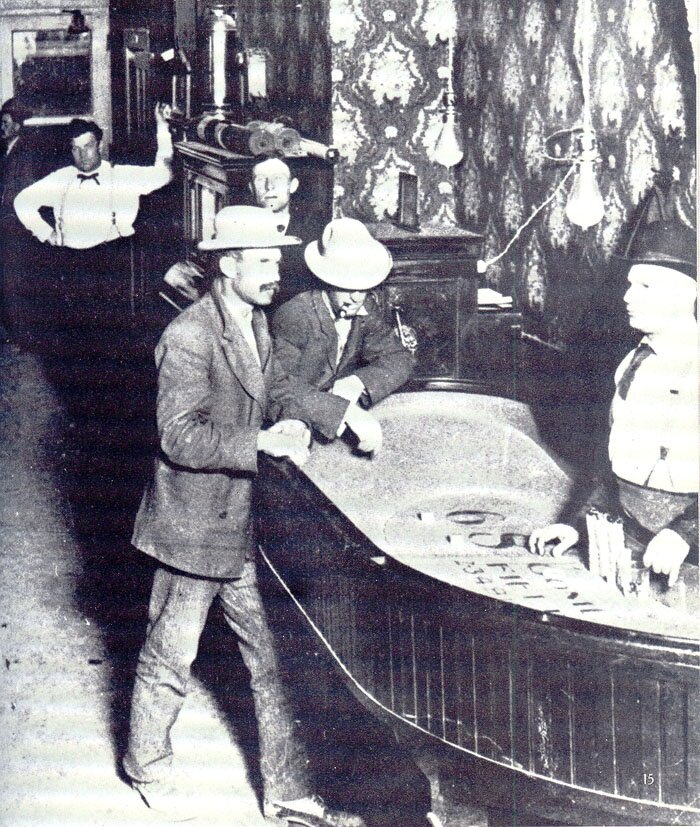


            Craps is a dice game in which players bet on the outcome of a roll (or series of rolls) on a pair of dice. Players can bet against each other or against the bank. Because the only equipment is the set of dice, this is an easy game to set up and play, and was very popular on the streets as well as in the gambling houses.


            Baccarat is a card game. There are three popular varieties: Punto banco (North American baccarat), baccarat chemin de fer, and baccarat banque (a deux tableaux). The first is simply a game of chance, with no skill or strategy involved, but the others allow players to make choices and bring a little skill to the game. Most casinos in the US, UK, Canada, Australia, and Sweden and Finland use the first version of the game. In baccarat, cards numbering 1 through 9 count at face value; 10 and face cards are worth nothing; and Aces are worth 1 point. The name itself refers to anything with a value of zero - a queen or king is a "baccarat." Cards are valued according to the final digit of the sum (a hand with a 3 and 4 would be 7, but one with a 3 and 9 would be 2). The highest hand would be a score of 9.


            Roulette is a game of chance played with a wheel (the name means "little wheel"). Players bet either red or black, odd or even, or on a specific number or range of numbers on the wheel. The wheel is spun in one direction, and a ball is spun along a track in the wheel in the opposite direction. The ball will drop into one of the colored and numbered pockets on the wheel. Another version, familiar as the "wheel of fortune," features a standing wheel with a marker to determine the final outcome of the spin.


            Faro (Pharoah, named because of the picture on the back of the typical cards) is a card game played against a bank. Players bet on one or more cards, or could bet "high card." The cards were dealt from a box, or shoe, which made cheating unlikely.


            Blackjack, also known as Twenty-One, is a card game played against a bank. Players are dealt cards one at a time, and try to either attain the sum of 21, or to beat the bank's score. Cards numbering 1 through 10 count at face value; face cards count as 10 points, and the ace can count either as 1 or 11 (if you have an ace and a queen, you have 21, but if you have an ace and a 5, it can count as 6 and you can keep drawing cards).
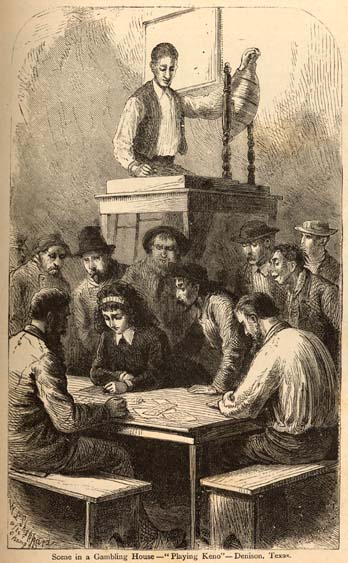

            Keno is a form of lottery or bingo. The Chinese played the game with sheets imprinted with 80 characters; the Europeans played with 80 numbered balls which were spun in a cage. 20 balls or characters are drawn, and players win based on how many numbers they successfully chose.


            Of course, no discussion of table gambling would be complete without the game of poker. The game as we know it today originated in America in the early or mid-18th Century, and had spread throughout the Mississippi River region by the 19th Century. The game itself is similar to many card games played in other countries, but the betting system is different enough that the Americans can claim its invention. The game was played in a variety of forms, with 52 cards, and included both straight poker (cards are dealt face down and bets are made without seeing the hands) and stud poker (cards are a mix of face-up and face-down, and bets are placed in multiple rounds). There was even a variant played using only 20 cards.

            Table games were hardly the only forms of gambling available. Various types of races have always been popular, with horse racing in the lead. However, people will bet on anything -- foot races, dog races, even camel races were popular! The basic philosophy of gambling is: if there is an outcome, you can bet on it. 


Saturday, December 1, 2012

Cattle Drives in 19th Century America


Cattle drives -- moving herds of cattle from one location to another on foot -- were especially important in the American west between 1866 and 1886. Around 20 million cattle were herded from Texas to stockyards in Chicago and other eastern cities. Long-distance cattle driving was traditional in Mexico, California, and Texas, and horse herds were sometimes also driven. The term "drive" does not refer to carrying, as in driving a vehicle, but to forcing the cattle to move forward.


Cattle drives had to strike a delicate balance: the cattle needed to move as quickly as possible, but not so quickly as to cause them to lose weight. Fat, healthy cattle brought the best prices at market. The ideal speed was somewhere between 10 to 15 miles in one day, with rest periods for grazing at midday and at night. This meant that a drive could take several months to complete on a long trail. One of the most famous trails, the Chisholm Trail, was 1,000 miles long, stretching from Texas to Abilene, Kansas.


The more cattle you could move, the more money you made when you sold them at the end of the drive. A typical drive consisted of 1,000 to 3,000 cattle. With this many cattle, it was highly profitable for a town to encourage a drive to pass through, or even make it their destination once the railroads began expanding. So-called cattle towns experienced a boom between 1866 and 1890, as railroads reached them and the towns made themselves available for gathering and shipping cattle. The most famous towns were railheads, where the herds were shipped off to Chicago stockyards.

Abilene, Kansas was one of the first, and most famous, cattle towns. Other Kansas towns included Wichita and Dodge City. There were certainly other famous cattle towns, however: Las Vegas, New Mexico; Greeley, Colorado; Medora, North Dakota; Cheyenne, Wyoming; Ogallala, Nebraska; Miles City, Montana; and Prescott, Arizona are but a few of them. Texas was a frequent starting point for many drives, and Amarillo, Fort Worth, and Wichita Falls were all important cattle towns.


A drive couldn't exist without the cowboy, of course. A crew of at ten to fifteen men was needed for a sizeable herd. Each man needed from five to ten horses (ridden in shifts so that no one horse became exhausted), so a drive also included a small herd of horses, called a remuda. The cowboys worked in shifts to watch the cattle around the clock, herding them in the right direction during the day and making sure they were safe at night. Theft was a big danger, as was a stampede, when cattle became frightened and dashed away at top speed in any direction.

A typical drive would consist of the trail boss, who might be the owner of the cattle, the crew of cowboys, a horse wrangler to handle the remuda, and the cook, who drove the chuck wagon. This wagon carried not only food for the crew, but also the medical supplies and bedrolls. The cook was especially well-respected by the crew for his knowledge of food and practical medicine. Payment depended on your previous experience and the job you worked. A trail boss could earn $90 a month on a drive, while a good cook could bring in $60 a month. Cowboys typically earned between $30 and $40 a month, and the horse wrangler, usually the youngest member of the crew, usually earned only around $25 a month.


Once the herd was moving, everyone had an assigned spot. A good trail boss would rotate the positions of his crew so that no one cowboy had to ride in the most unpleasant spots all the time. First out of the camp would be the chuck wagon. This would travel in front of the herd, and usually be out of sight before long. A scout traveled ahead of the herd as well, seeking out the best routes and serving as go-between for the chuck wagon and the trail boss. The main herd followed the trail boss and the point riders to his right and left. Swing riders were positioned to either side of the herd, and were responsible for keeping the cattle bunched together, chasing down stragglers and driving them back into the herd.  To the back of the herd, in roughly the same positions as point, were the flank riders. Their job was to push the herd along, making sure they kept to the desired speed. The worst job of all was drag, which was directly behind the herd, pushing them forward and watching for stragglers. Drag riders were covered with dust and less-desirable products of the cattle, kicked up by thousands of hooves.


Here are some words of wisdom from cattle rancher Oscar Thompson to his son Webster before his first drive:

11.     First of all, obey your boss -- he's paying you for your service.
22.     When you camp at night, always point your wagon tongue toward the North Star.
33.     Explain to your men in a quiet voice what they are to do.
44.     Never say "no" to your employer.
55.     Be ready to go at all times.
66.     Don't say "You boys do this," but "Come on, boys, follow me."
77.     Put your best two men on point.
88.     Water your cattle and fill them up before night.
99.     Explain to your cook that he must be ready with meals at all times.
110.  Watch your horses -- don't let the men abuse them.
111.  Keep your harness and camp equipment clean and up out of the sand.
112.  Don't fight your men unless they jump you; but if they or anyone else jumps you, give them the best you have.
113.  Don't ever misrepresent anything to your employer; tell it just like it happened.
114.  Don't get rattled. No matter what happens, keep your head clear.
115.  Don't lose confidence in yourself.
116.  Look after the comfort of your men, and they will follow you to hell.
117.  Keep your mind on your business and make your head save your heels.

Saturday, November 3, 2012

More Victorian Manners


Victorian Entertaining


Source: The Essential Handbook of Victorian Entertaining, adapted by Autumn Stephens, Bluewood Books, 2005

There was no such thing as casual entertaining in the 19th Century. A minor social blunder could ruin someone's reputation! The essential rules of etiquette were printed in numerous books and followed religiously by anyone who aspired to any sort of social standing.


Calling and Calling Cards:

The social call was an important ritual during the Victorian era. Calling cards evolved in England as a way to screen callers and keep out undesirable visitors. These cards were usually 9cm x 6cm. A lady's card was larger than a gentleman's, who had to fit his in his breast pocket. The card was made of heavy white paper, plain and unruled, "elegantly engraved" -- highly decorated or gaudy cards betrayed ill breeding.

The engraving was in simple type, small and without flourishes, although script became more elaborate as the century went on. A simple 'Mr.' 'Mrs.' or 'Miss' before the name was sufficient, except in the case of acknowledgement of rank (Earl, Viscount, etc.). Early Victorian cards bore only a person's title and name, with the name of their house or district sometimes added. By the end of the century, the address was added to the card, and when applicable, a lady's reception day.
These cards were usually carried in special cases, made of ivory, tortoiseshell, leather, or even paper-mache. The truly wealthy carried cases of silver or gold.
Specific times were allocated for different types of calls. A "morning call" was made in the afternoon. "Ceremonial calls" were made between three and four o'clock, "semi-ceremonial calls" were between four and five o'clock. Calls made between five and six o'clock were deemed "intimate calls." Sundays were always reserved for friends and family only. Visits were always quite short, lasting from ten to thirty minutes, and if another caller arrived during a visit, the first caller was expected to leave within a few minutes of the second caller's arrival.
Occasions which warranted a social call were many. Calls of condolence or congratulations, of course. Yet proper etiquette also required social calls for many occasions which today would be properly resolved with a polite letter; one was not allowed to express thanks, tender regrets, or even accept an invitation with a written message. You must pay a return call within three days of another party's first call upon you. You must also pay a call upon friends prior to departing from town and after returning.
As soon as a family arrived "In Town," the wife and mother was expected to circulate not only her card, but her husband's and those of her sons and daughters as well. She could either deliver the cards herself, waiting within the carriage to see if the mistress of the house was "at home" ("not at home" was a polite rejection of her family), or she could send the cards around by a servant. Upon receiving a card, one should reply with their own card, either delivered by hand or by a servant. A social call was returned with another social call.


Rules for calling:
Always....
·      - dress for calling; ladies who are "at home" should wear tasteful clothing, "with a certain amount of lace and jewelry" (but no artificial flowers or glittering gems); callers should wear the sort of clothing they would wear to church or an afternoon reception; a gentleman wears a "morning" suit until six o'clock (gray, striped trousers, black vest and coat, bowler or top hat) and evening attire after that (a black dress suit)
·      - receive visitors at whatever time they should call; if you cannot be interrupted, have the servant say that you are "engaged" rather than telling the falsehood that you are "not at home"
·      - greet the hostess politely as soon as you are shown into the drawing room or parlor
·      - make your conversation bright and witty

Never....
·      - take young children or pets when making social calls
·      - look at your watch
·     -  be in haste to seat yourself; stand and converse for a few moments
·    - stare or meddle with the articles in the room; do not seem to be aware of anything but the company present while visiting
·     -  walk around the room staring at the pictures and other objects while waiting for the hostess
·     -  call across the room to address anyone; cross the room and speak quietly
·      - introduce politics, religion, or other weighty topics to the conversation
·     -  scratch your head or use a toothpick, earspoon, or comb
·    -   tell long stories, talk scandal, or spread rumors
·    -   make any remarks about another caller who has left the room

Tuesday, October 30, 2012

Westernisms


Americanisms, Part 2


The American Old West produced many a decorative phrase! If you were angry, you could be proddy, wrathy, techy, prickly, or all horns and rattles (angry cows rattle their horns). If you wanted to enjoy a bit of tobacco, you could fill a blanket or build a smoke by shaking a little Bull Durham into a sheet from your prayer book (packet of cigarette papers) and rolling it up. A flannel mouth or four-flusher was a boaster, and you might want to clean his plow or sharpen his hoe (thoroughly defeat him).


They had a lot of terms for leaving in a hurry - evidently this was quite a common occurrence at that time.

Break down timber/ bust down timber - to head out at such a speed that you take down trees that are in your way

Burn the breeze - to ride fast enough to set the wind on fire

Fixing for high-riding - "fixing" was a general-purpose term that basically meant whatever you wanted it to, from your "fixings" as in your belongings to "fixing to" meaning "going to" - in this sense, it means "getting ready"

Flag your kite - putting a flag on your kite means it's ready to fly

Fogging it or Frogging on - "fogging it" is thought to be a corruption of the term "frogging on" which was commonly used at the end of the century; it means to travel rapidly, particularly on horseback

Get up and dust/ dust out of - to leave nothing behind but a trail of dust

High-tail - when a horse starts to gallop, it throws its tail up high

Hit the breeze - also "hit the trail," which can just mean "to leave"

Hump your tail/ hump yourself - an ornery horse humps up its back before it starts bucking

Jump up a lot of dust - to depart so rapidly that you leave a trail of dust behind you

Kite - literally, to fly away

Light a shuck/ light out - when leaving a campfire, it was common at one time to light a corn shuck (husk) and carry that as a torch to find your way home

Make tracks - to leave nothing of yourself behind except the tracks

Raise the dust - leave a trail of dust behind you

Rattle your hocks - hocks are the ankle bones of a horse

Roll your tail - a cow that is ready to run will roll its tail up near the body

Sail away - as a ship departs under sail

Tail out - a variation of "high-tail"

Take it on the run - "it" being yourself and your belongings


There were also a lot of colorful nicknames for items the Westerners would have bought:

Airtights - canned goods

Arbuckle - a brand of coffee, thus any coffee

Arizona Strawberry, also Arkansas Strawberry, Prairie Strawberry, Mexican Strawberry - beans

John B - a cowboy's hat; from John B. Stetson, a famous hatmaker

Love Apples - canned tomatoes

Lucifer - a strike-anywhere match

Meat Biscuit - canned beef

Mexican iron - rawhide

Prairie Coal/ Buffalo or Cow Chips/ Surface Coal - dried dung of buffalo or cow, full of undigested grass and thus useful for burning

Salt Horse - corned beef

Sinkers - biscuits, supposedly to hard that they sank in liquid

Whiskey and other alcohol had practically their own dictionary of nicknames: 40-rod lightning, anti-fogmatic, baldface, blackstrap, brave-maker, nose paint, rookus juice, tangle-leg, Taos lightning, tarantula juice, tongue oil -- and if you consumed too much, you'd have a brick in your hat.