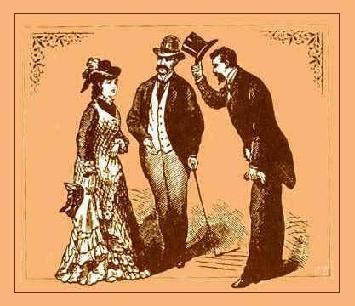
Source: Manners and Morals of Victorian America, Wayne Erbsen, Native Ground Books, 2009
19th Century etiquette books were filled with things to do
-- and things not to do. Here are some behaviors that are deemed entirely too
annoying. Mr. Erbsen has taken these verbatim from many sources of the era.
"Many a man would give much to be rid of habits
fastened upon him in youth, and which have been clogs and fetters, making every
step of progress in certain directions toilsome and painful. He has accomplished
only half of what he might have accomplished but for these annoying and
irritating shackles."
Children and Pets: "Never allow a child to pull a visitor's
dress, play with the jewelry or ornaments she may wear, take her parasol or
satchel for a plaything, or in any way annoy her"
"Callers should never take children or pets with them,
as they are apt to be very annoying to some people."
"Never allow a child to play with a visitor's hat or
cane."
"No dog, however 'dear or interesting' can be admitted
to the drawing room, and it is bad taste to have one follow you from home, if
you intend to make calls."
"Do not allow your children to be troublesome to
visitors; to climb upon them, soil their dresses with their fingers, handle
their jewelry and ornaments, ask annoying questions, nor intrude themselves
into their private apartments at unseasonable hours. To permit children to
follow company about, never giving them a moment of retirement, standing by
while they make their toilet, is not only annoying, but is vulgar."

Civility at a Concert:
"If you are at a concert, or a private musical party, do not beat time
with your feet or a cane upon the floor. It is mighty vexatious."
Cleanliness:
"Bad smelling persons are exceedingly disagreeable companions."
"Cleanliness and neatness are the invariable
accompaniments of good breeding. Every gentleman may not be dressed
expensively, he may not be able to do so; but water is cheap, and no gentleman
will ever go into company unmindful of cleanliness either in his person or
apparel."
Devil's Tattoo:
"Do not beat 'the devil's tattoo' by drumming with your fingers on a
table; it cannot fail to annoy everyone within hearing, and it is an index of a
vacant mind."
Eating:
"Don't eat fruit, or anything else on the public streets. A gentleman on
the promenade, engaged in munching an apple or a pear, presents a more amusing
than edifying picture."
Ego: "One
should by all possible means avoid egotism, for nothing is more displeasing and
disgusting. Never make yourself the hero or heroine of your own story. Do not
attempt a find flight of language upon ordinary topics."
"There is no surer sign of vulgarity than the perpetual
boating of the fine things you have at home -- if you speak of your silver, of
your jewelry, of your costly apparel, it will be taken for a sign that you are
either lying
Fidgetiness in Public:
"Avoid restlessness in company, lest you make the whole party as fidgety
as yourself."
"Do not whistle, loll about, scratch your head, or
fidget with any portion of your dress while speaking. 'Tis excessively awkward,
and indicative or low breeding."
Grinning:
"Don't have the habit of smiling or 'grinning' at nothing. Smile or laugh
when there is occasion to do either, but at other times keep your mouth shut
and your manner composed."
Interrupting:
"To interrupt a person when speaking is the height of ill manners, and may
justly cause indignation on the part of one so interrupted."

Looking at Your Watch:
"It is in bad taste for a caller to preface his or her departure by
consulting a watch, remarking, 'Now I must go,' or insinuating that the hostess
is weary of the visitor."
Mimicry:
"Mimicry is the lowest and most ill-bred of all buffoonery. Swearing,
sneering, private affairs either of yourself or any other, have long ago been
banished out of the conversation of well-mannered people."
Misery on a Train:
"In a railway coach, it is a distinct misery to sit near a party of people
who are eating peanuts and scattering shells upon the floor, and the odor of
oranges and bananas on a train is nauseating."
"Passengers should not carry anything on the train that
would be offensive to others. They should most rigidly avoid boarding the train
with dogs of any kind, whether spaniels, pointers, or poodles."
Nail Biting:
Biting the nails is one of the most annoying habits, and yet one which almost
any boy will fall into unless his mother 'nips it in the bud.' A habit of
tapping the floor with the foot, or the table with the knuckles, comes on
gradually, but, once fixed, is exceedingly difficult to overcome. 'Eternal
vigilance' should be a mother's watchword, for the true secret of curing bad
habits is in never allowing them to be formed. The 'ounce of prevention' is
worth more than the 'pound of cure.'
Smoking: "One
may never smoke in the company of the fair. One must never smoke in the
streets, that is, in daylight. The deadly crime may be committed, like
burglary, after dark, but not before. One must never smoke in a closed
carriage. Besides being coarse and atrocious, smoking is very bad for the
health."
"The tobacco smoker, in public, is the most selfish
animal imaginable; he perseveres in contaminating the pure and fragrant air,
careless whom he annoys, and is but the fitting inmate of a tavern."


Vulgar Acts: When
committed in the presence of others, the following acts were classed as
vulgarities.
·
To stand or sit with feet wide apart
·
To hum, whistle, or sing in suppressed tones
·
To use profane language, or stronger expression
than the occasion justifies
·
To chew tobacco and spit
·
To correct inaccuracies in the speech of others
·
To stand with arms akimbo
·
To lounge, or yawn, or do anything which shows
disrespect or indifference
Whispering.
"Do not read the newspaper in an audible whisper, as it disturbs the
attention of those near you. Remember, that a carelessness as to what may
incommode others is the sure sign of a coarse and ordinary mind."
"It is rude to whisper or talk during a performance. It
is discourteous to the performers, and annoying to those of the audience around
you, who desire to enjoy the entertainment. To seek to draw attention to
yourself at a place of amusement is simply vulgar."
"There cannot be a custom more vulgar or offensive than
that of taking a person aside to whisper, in a room with company; yet this
rudeness is of too frequent occurrence."